

What Does It Take to Keep a Drainage Channel Working?
Drainage channels rarely get much attention until they stop working.
When a channel erodes, scours or becomes overgrown, water stops going where it’s meant to. When that channel sits beside a motorway, a railway line or the crest of a slope, the problem quickly spreads beyond the channel itself.
With autumn rainfall picking up, this month we’re looking at four recent projects where Concrete Canvas® GCCMs were used to line drainage channels across mining, road and rail. Each one had a different challenge to solve.
So, what was each project up against?
What happens when the channel protecting a slope starts to erode?
At a reclaimed mine, a crest drainage channel was being heavily scoured during rain and storm events, putting the slope at risk of slipping. The client needed a hard-armoured solution that wouldn’t disrupt mine operations.
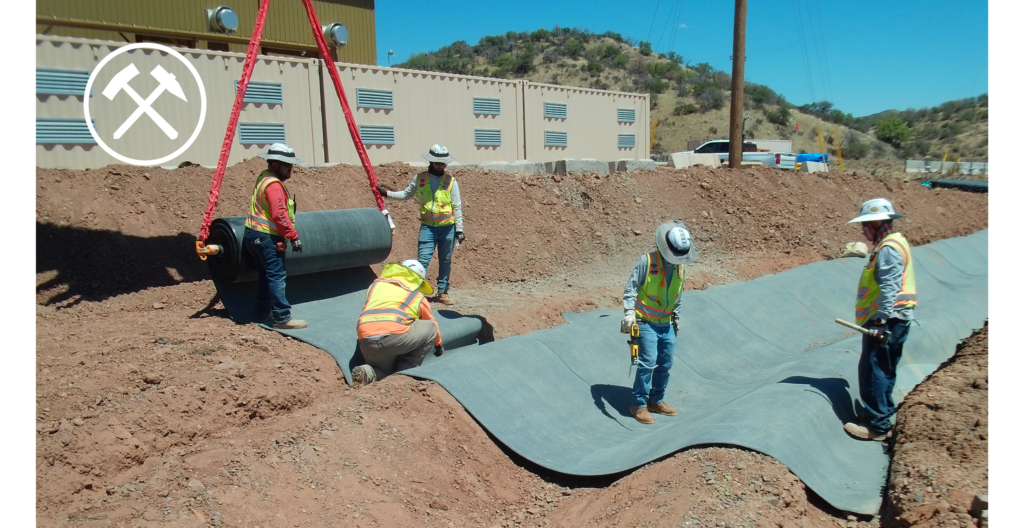
A team of 12 from Rummel Construction Managers installed 26,572ft² (approx. 2,470m²) of CCX-M®, deploying Bulk Rolls across the channel with an excavator and spreader beam. The team found it easy and quick to install, and were enthused with the idea of installing more of it instead of traditional methods.
When a drainage channel is protecting the ground around it, keeping it in good condition protects the whole site.
Can drainage works fit around a live motorway?
Two roadside channels beside the M8, the main route between Glasgow and Edinburgh, were overgrown and eroded. They were also struggling with runoff from an adjacent field, which added to flooding on this stretch of motorway. BEAR Scotland proposed CCT2® instead of the poured concrete originally considered.
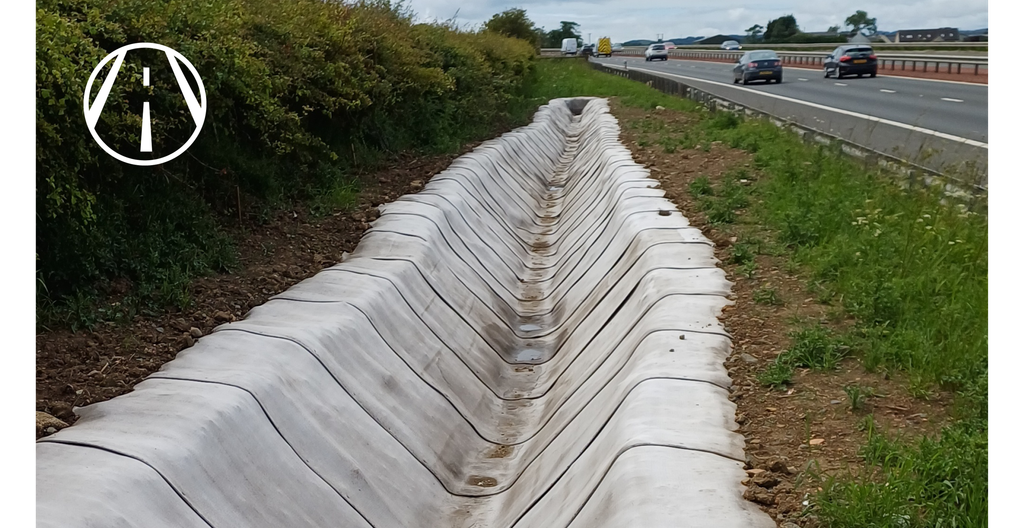
To avoid daytime lane closures, a team of 7 worked night shifts and installed 825m² across 211 linear metres of channel in less than two weeks, within the project schedule.
On a strategic route, the installation window can matter as much as the solution itself.
What if the obvious fix creates a maintenance problem later?
An unlined channel beside an active railway line had become so overgrown that it could no longer manage the water, causing localised flooding. Once the vegetation was cleared, both sides were found to be heavily scoured. Seeded matting was considered, but it would have needed regular maintenance to stop vegetation blocking the channel again.
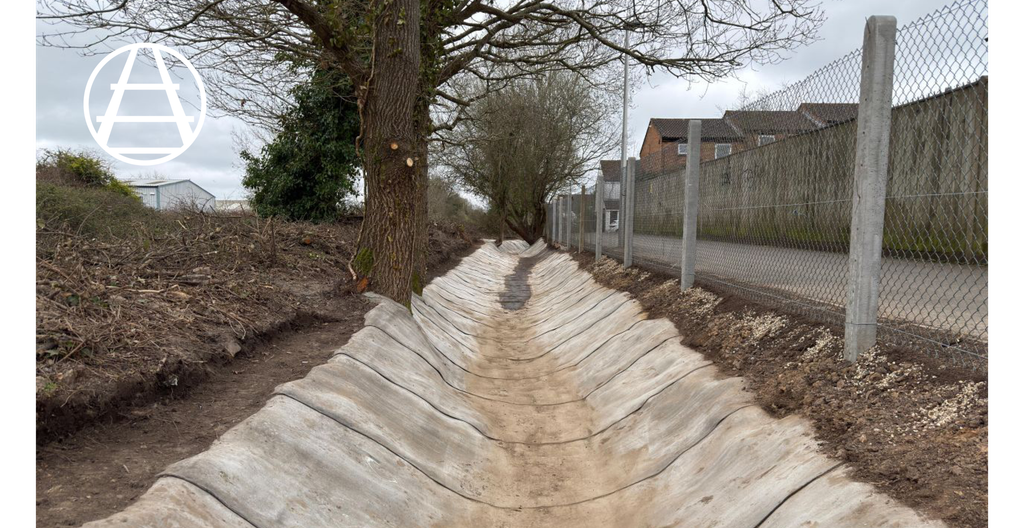
With Network Rail already familiar with Concrete Canvas from other projects in Devon, CCT2® was specified for the project. AC Construction hand-installed 300m², and the whole project, including ground preparation and rip-rap, was finished in 3 weeks.
“The material proved straightforward to handle and install, allowing the team to progress quickly while maintaining quality throughout.” – Sahil Patel, Site Agent, AC Construction
For asset teams, low maintenance is often what makes a solution work long term.
Is poured concrete always the right answer for a new channel?
The Sizewell C highway improvements included a new drainage channel at the Friday Street Roundabout. 100mm ST2 concrete was originally specified, but Breheny Civil Engineering proposed CCT2® through a Technical Query. WSP then specified it in Batched Roll format.
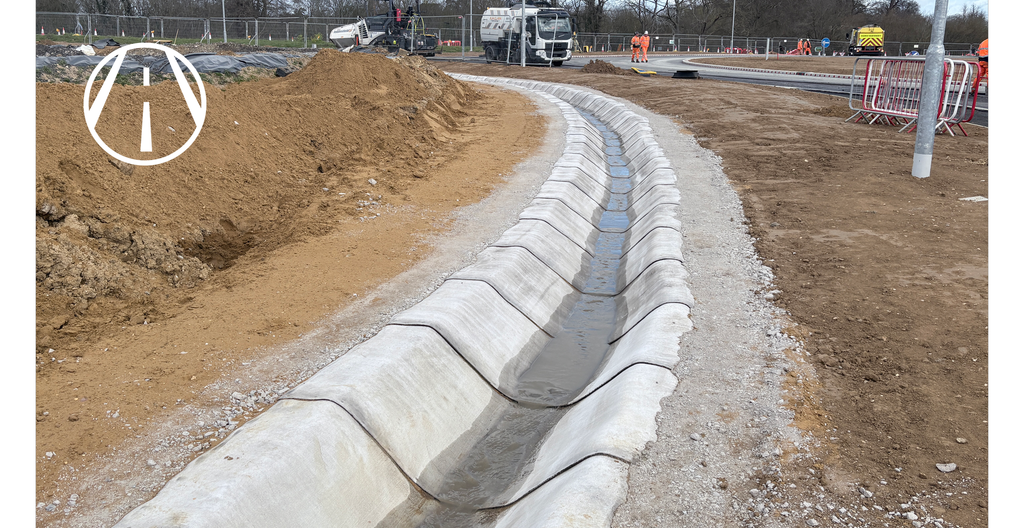
The result was:
- Around 50% less embodied carbon (3,640 kgCO₂e saved)
- 66% lower material and installation costs
- 175m² installed by hand in just one day by a team of 3, with no heavy machinery
GCCMs aren’t only for repairs. They can also be designed into new infrastructure from the start.
So, What Do These Projects Tell Us?
All four were drainage channels, but each had a different constraint: a slope at risk, a live motorway, a maintenance burden and a concrete specification under pressure on cost and carbon.
A few common threads are emerging:
- Access and possession windows are shaping material choice
- Long-term maintenance matters as much as the initial installation
- Cost and embodied carbon are driving specification changes
As weather events become more frequent and more intense, keeping water moving where it should is becoming an important part of protecting the infrastructure around it.